
Our Lab
We turn waste into useful materials. At SusMatLab, PET bottles become CO2-capturing MOFs, discarded textiles become water-purifying hydrogel sheets, crab shells become heavy-metal adsorbents, and waste-derived polymers become soil stabilizers tested in the field.
Our research combines polymer and colloid science with environmental engineering to build practical routes from plastic and biomass waste to functional materials. We work with abundant, low-cost feedstocks and the waste streams that most processes discard.
We publish in leading journals of chemical and environmental engineering and collaborate with academic and industrial partners in Japan and abroad. Through research and education, we aim to make waste a source of solutions rather than a burden.
Recently published
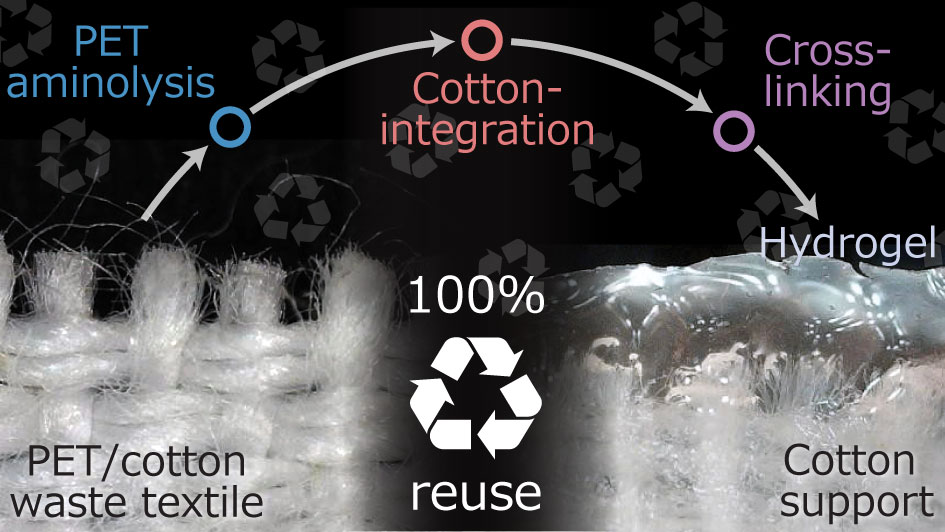
Hydrogel Sheets from Waste Textile
Separation-free upcycling of PET/cotton waste textiles into reusable hydrogel adsorbents for water purification.
Read more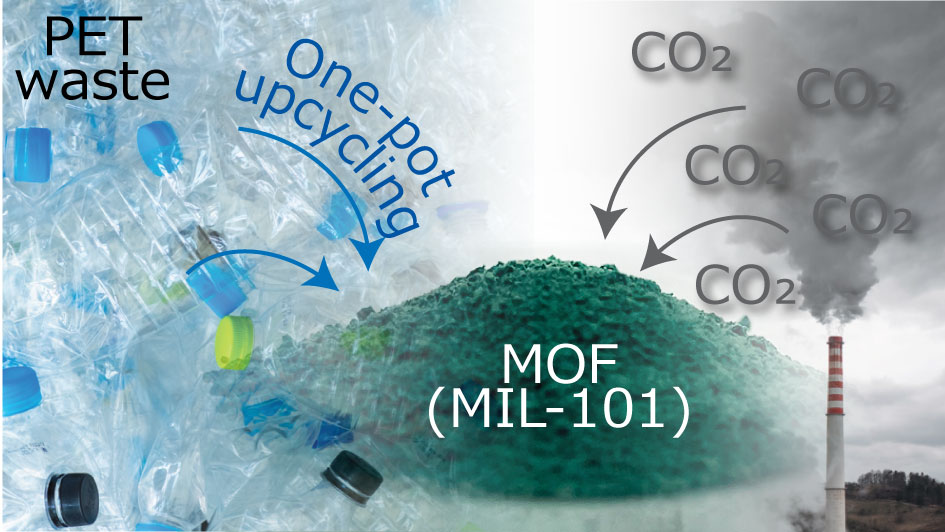
CO2 Adsorbent from Waste PET
Upcycling waste PET into porous materials for efficient CO2 capture.
Read more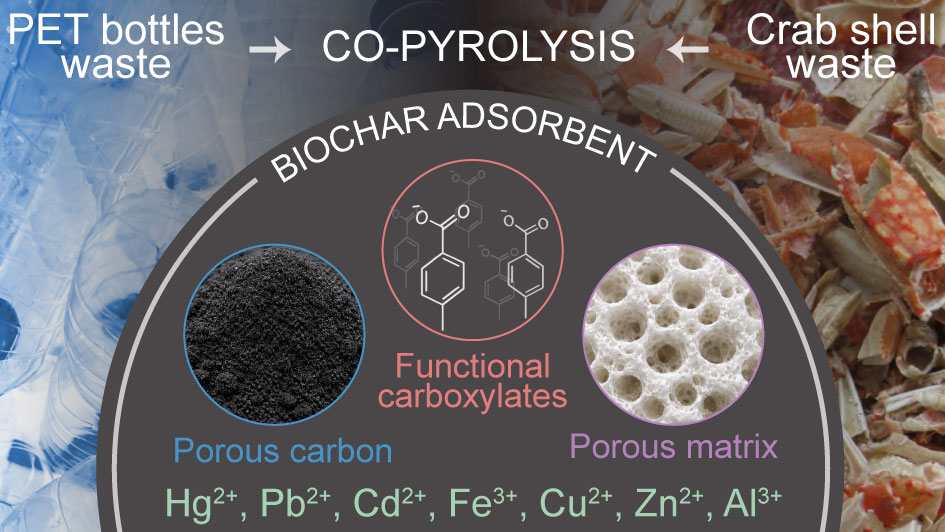
Waste-Derived Biochar Adsorbent
Porous adsorbents for heavy metal removal produced via co-pyrolysis of PET bottle waste and crab shell waste.
Read moreNews
2026.09.28 Aron (D1) gave an oral presentation at the International Conference on Next Horizons in Polymers (IUPAC-PSK50) in Busan, Korea.
2026.09.16 A new member, Matilde BERTANA (M1) has joined us.
2026.08.07 Khonekeo (D3) has successfully passed his doctoral dissertation examination.
2026.07.30 Hanan (D2) gave an oral presentation at IUPAC MACRO 2026 in Kuching, Malaysia.
2026.06.03 The paper of Aron (D1) on the upcycling of blended PET/cotton textiles into pollutant adsorbent sheets was published in Journal of Cleaner Production.
2026.05.01 Nagoya University issued a press release on the direct synthesis of chromium-based MOFs from waste PET bottles and their application to CO2 capture.
2026.04.19 A paper by Kayee Chan (graduated in 2025) on the direct synthesis of chromium-based MOFs from waste PET bottles and their application to CO2 capture was published in the Chemical Engineering Journal. This work was conducted in collaboration with the group of Prof. Yoshiaki Kawajiri and Assoc. Prof. Frantisek Miksik.
2026.04.10 The paper of Khonekeo (D3) on the enhancement of heavy metal adsorption properties of crab shell waste-derived biochar by co-pyrolysis with PET plastic waste was published in the Journal of Environmental Chemical Engineering.
2026.04.01 New members, Snigdha DAS (D1) and Takahisa YAMADA (M1) have joined us. Guanglong HUANG (D1) started his doctoral course.
2025.12.30 Our joint research with the Geotechnical Laboratory of the Department of Civil Engineering (Nagoya University) on soil improvement with biomass nanofibers has been published in International Journal of Biological Macromolecules.
2025.12.19 The paper of Xin Lin and Nobuyuki Shibata from the Nagoya Municipal Industrial Research Institute on the extraction of gold from e-waste by organic solvents was published in Separation and Purification Technology.
2025.12.03 Prof. Zinchenko delivered a talk at the Biennial Polymer Congress 2025 (FAPS 2025) in Singapore.
2025.12.01 A new member, Dr. Tan Phat VO (JSPS Postdoc) has joined us.
2025.09.29 New members, Guanglong HUANG (RS) and Xinyun YU (NUPACE) have joined us.
2025.08.27 Prof. Zinchenko delivered a keynote lecture at the Asia-Pacific Chitin and Chitosan Symposium (APCCS 2025) in Taipei, Taiwan.
Contact
Graduate School of Environmental Studies, Chikusa-ku, Furo-cho, Nagoya, 464-8601, Japan
Tel: +81-52-789-4771
E-mail usAccess
Graduate School of Informatics building, 7th floor, room 701 (Zinchenko) and room 711 (student room)
Google map